

How to Survive Pride When You’re Socially Anxious
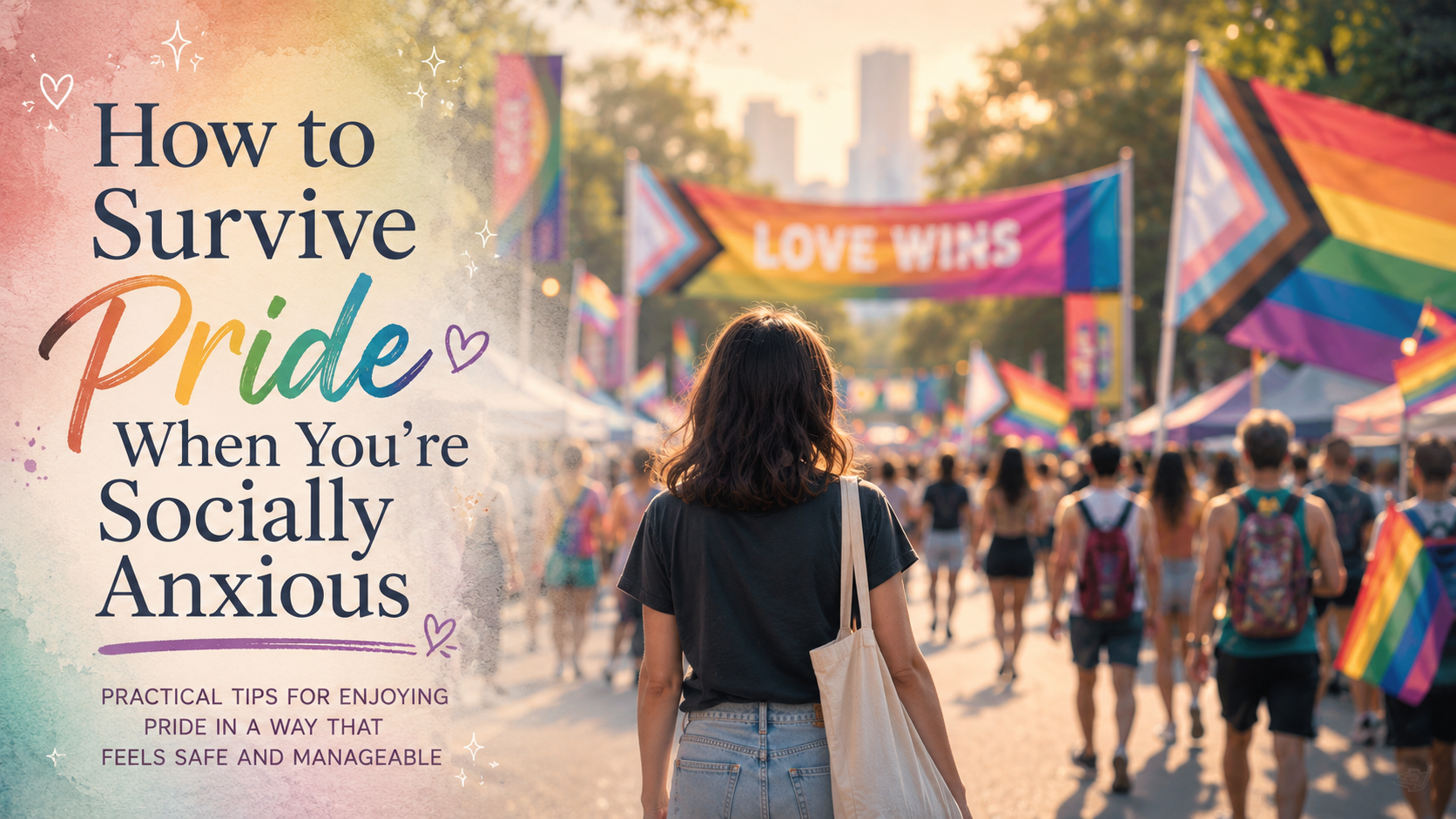
Pride can be a lot. For some people, it’s one of the few places where they get to be fully themselves without looking over their shoulder. It can be affirming, joyful, emotional, and healing… It can also be loud, crowded, hot, overstimulating, unpredictable, and filled with approximately 4,768,312 strangers.
If you’re socially anxious, that combination can be a little complicated.
I’ve had clients tell me they spend weeks looking forward to Pride, only to find themselves dreading it as the date gets closer. They want to go. They want to feel connected to their community. They want to celebrate. They also find themselves imagining every possible awkward interaction, worrying they’ll run into someone they know, stressing about parking, wondering whether they’ll have anyone to talk to, and debating whether staying home would be easier.
All of that makes sense. Social anxiety doesn’t disappear just because you’re entering a space that’s affirming. In some ways, it can actually become more complicated.
Why Pride Can Feel So Intimidating
Part of social anxiety is the tendency to assume everyone is paying far more attention to us than they actually are. Pride creates the perfect environment for that anxiety to get loud. You’re surrounded by people. There are conversations happening everywhere. There are often performances, activities, vendors, and opportunities to interact with strangers. If you already worry about saying the wrong thing or looking awkward, your brain may start treating the entire event like one giant social performance.
There is also another layer that often gets overlooked. For many LGBTQIA+ people, Pride isn’t just a festival. It can carry emotional weight. Maybe this is your first Pride. Maybe you’re newly out. Maybe you’re not out to everyone. Maybe you grew up in an environment where being LGBTQIA+ was treated as something shameful or dangerous. Maybe you live in a community where seeing thousands of openly queer people feels both wonderful and unfamiliar.
That emotional significance can raise the stakes in your mind. When something matters, anxiety tends to show up.
The Safety Piece
I would be doing you a disservice if I pretended safety concerns don’t exist. Many LGBTQIA+ people are navigating a political and social climate that feels increasingly hostile. Depending on where you live, attending Pride may bring up legitimate concerns about harassment, protests, discrimination, or simply being visibly associated with a community that is currently receiving a great deal of negative attention.
It is important to recognize the difference between realistic concerns and anxiety-driven catastrophizing. Realistic concerns deserve planning. Anxiety-driven catastrophizing tends to demand certainty. One of those is useful. The other will keep you stuck. You do not need to convince yourself that nothing bad could ever happen. That’s not realistic. You simply need a reasonable plan. Know where you’re going. Attend with friends if that feels safer. Keep your phone charged. Know where exits, transportation, and meeting locations are. Pay attention to your surroundings. Then allow yourself to stop preparing.
At some point, additional planning stops increasing safety and starts feeding anxiety.
Before You Go
One mistake I see people make is treating Pride like an exposure exercise they have to endure for eight straight hours. You do not get extra credit for suffering. Give yourself permission to attend for one hour. Seriously. You can always stay longer. It’s much easier to tell yourself, “I’m going to check it out for an hour,” than, “I’m committing my entire day to navigating giant crowds and social interaction.”
I would also encourage you to think through a few practical details ahead of time:
Figure out transportation before the day arrives.
Wear comfortable clothes and shoes.
Bring water if it’s allowed to be brought in and plan to buy some if not.
Eat something beforehand.
Charge your phone.
Decide where you’ll take breaks if you need them.
These things sound boring, but it’s amazing how often anxiety becomes worse when you’re dehydrated, hungry, overheated, and trying to figure out where you parked.
If You’re Going Alone
A lot of people go to Pride alone. A lot more than you probably think. Social anxiety has a way of convincing us that everyone else arrived with a perfectly curated friend group while we’re the only awkward person standing by ourselves. That usually isn’t true.
There will be people attending with partners. There will be people attending with friends. There will also be plenty of people wandering around on their own, looking at booths, watching performances, and trying to decide whether the food truck line is worth it.
Going alone is not evidence that something is wrong with you. It’s just one way people attend events. You do not have to spend the entire day talking to strangers to justify being there.
What To Do When Anxiety Shows Up
Notice that I said when, not if.
The goal is not to eliminate anxiety. The goal is to keep anxiety from becoming the person in charge. When you notice yourself spiraling, try bringing your attention back to what is actually happening around you. Look for five things you can see. Notice what music is playing and try to pick out what instruments are making the music. Pay attention to the color of the flags around you. Feel your feet on the ground. Take a slow drink of cold water.
These skills sound incredibly basic because they are. Anxiety pulls us into imagined futures. Grounding helps pull us back into the present. You do not need a perfect mindfulness practice. You just need something that interrupts the spiral.
Give Yourself Permission To Leave
This might be the most important tip in the entire article. You are allowed to leave. You are allowed to leave after twenty minutes. You are allowed to leave after two hours. You are allowed to leave and come back later. You are allowed to decide that this particular event is not the right fit for you.
One of the strange things about social anxiety is that we often create a trap for ourselves. We tell ourselves that if we go, we have to stay. If we stay, we have to enjoy it. If we don’t enjoy it, we’ve somehow failed. None of that is true. The success metric is not whether you had the perfect Pride experience. The success metric is whether you showed up for yourself in whatever way felt manageable for you.
You Don’t Have To Become an Extrovert To Belong
Pride can be a beautiful reminder that you are not alone. It can also be overwhelming. Both things can be true at the same time. You don’t have to be the loudest person there. You don’t have to make new friends. You don’t have to stay all day. You don’t have to enjoy every minute. You do not have to become someone else to deserve a place in your community.
Sometimes belonging looks like dancing in the middle of a crowd. Sometimes it looks like quietly watching from the edge with an iced coffee and an exit plan. Both count.
If You Grew Up in a Conservative or Religious Environment
For some people, the anxiety isn’t really about the crowds so much as what Pride represents.
I’ve worked with many people who grew up in conservative religious environments where LGBTQIA+ identities were treated as sinful, dangerous, broken, or something to be avoided entirely. Even if you’ve spent years questioning those messages, they don’t always disappear overnight.
Attending Pride for the first time can bring up a surprising mix of emotions. You might feel excited or relieved. You might feel emotional seeing hundreds or even thousands of people openly celebrating identities that you were taught to hide, fear, or judge, but you might also feel anxious, guilty, uncomfortable, or completely out of place.
None of those reactions mean you’re doing anything wrong. Sometimes people expect Pride to feel immediately freeing. Instead, they find themselves scanning the crowd, feeling self-conscious, wondering if they belong there, or hearing old messages from their upbringing suddenly get very loud.
That doesn’t mean you’ve made the wrong choice by attending. It just means you’re encountering something that challenges years of conditioning.
If this is your first Pride, try to let yourself be an observer. You don’t have to march in the parade, make a statement, and know all the terminology. You can simply show up and notice what it’s like to be in a space where people are allowed to exist as themselves. Sometimes that’s more than enough for a first visit.
Sometimes people expect Pride to feel immediately freeing. Instead, they find themselves scanning the crowd, feeling self-conscious, wondering if they belong there, or hearing old messages from their upbringing suddenly get very loud.
You don’t need to earn your place there. You don’t need to prove that you’re queer enough, out enough, confident enough, or politically engaged enough. You can just be a person having a new experience and figuring out what it means to you.