

Political Anxiety Is Real. Here’s What Actually Helps.
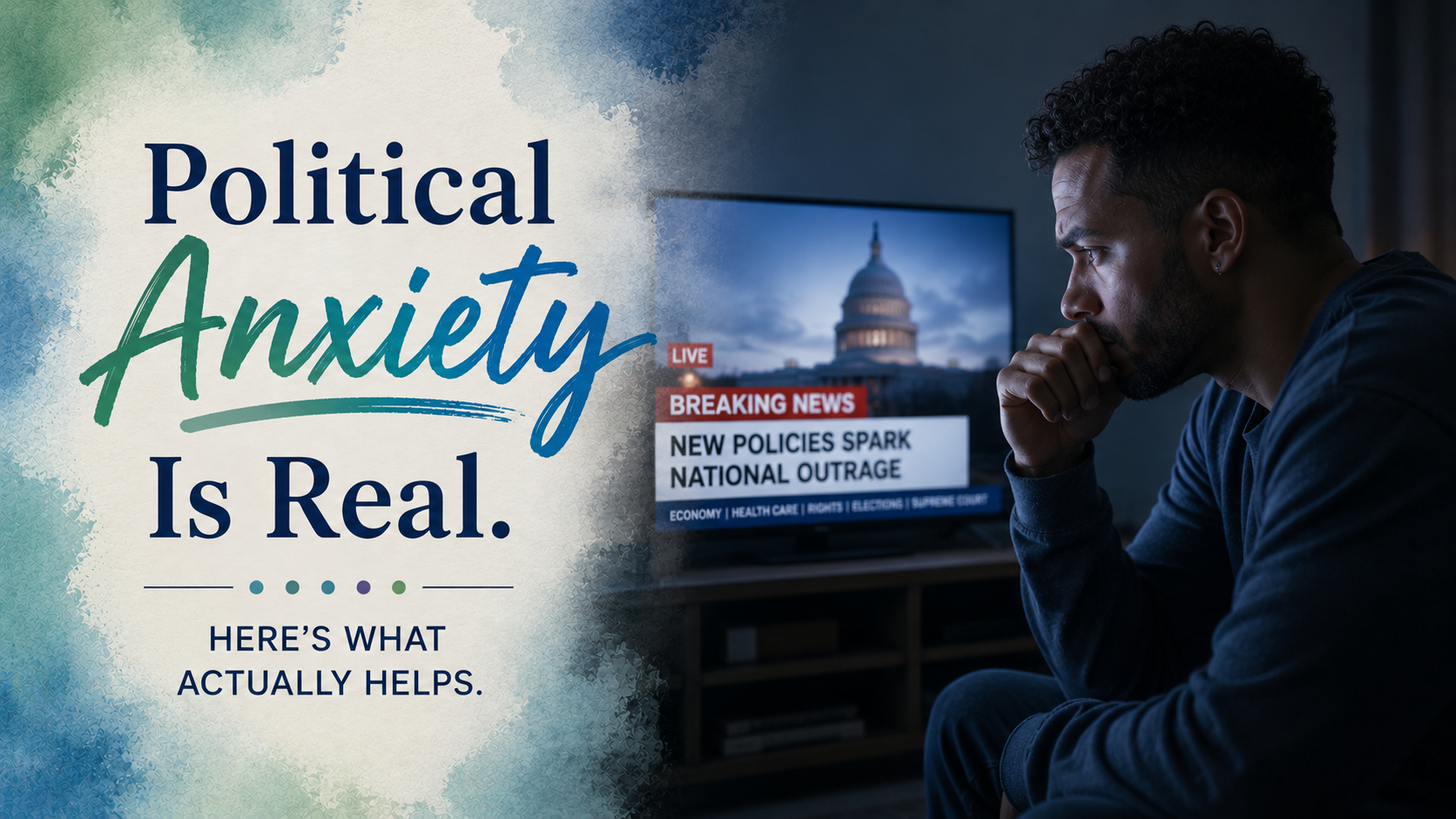
If you’ve found yourself feeling more anxious, angry, exhausted, distracted, or overwhelmed over the last several years, you’re not alone.
I’ve noticed a pattern with many of my clients. They’re not just stressed about work, relationships, finances, or whatever personal challenges brought them into therapy originally. They’re also carrying the emotional weight of what feels like a never-ending stream of political news, social conflict, court decisions, elections, policy changes, and public debates about issues that affect their lives.
For some people, politics feels abstract. For others, it doesn’t. In fact, it often can’t. If you’re LGBTQIA+, an immigrant, a person of color, someone concerned about reproductive rights, someone navigating religious trauma, or simply someone paying attention to what’s happening around you, politics is intensely personal.
When policies affect your family, your healthcare, your relationships, your safety, or your future, it makes sense that you’re having an emotional reaction. The goal of this post is not to tell you not to care. The goal is to help you care without burning yourself to the ground.
First, Let’s Stop Calling Everything Catastrophizing
One of the things I dislike about some anxiety advice is that it assumes every fear is irrational. Sometimes people are catastrophizing, but a lot of times, they’re responding to real uncertainty. Those are not the same thing. If you’re worried about something that could realistically impact your life, your concern isn’t necessarily evidence that your anxiety is lying to you.
The problem usually isn’t that you care. It’s that your brain keeps demanding certainty about things that nobody can know yet. You can spend six hours reading articles, scrolling social media, refreshing news feeds, and arguing with strangers online. At the end of those six hours, you’ll probably know slightly more information.
You still won’t know the future.
Unfortunately, anxiety hates that.
Doomscrolling Feels Productive. It Usually Isn’t.
Most people know doomscrolling isn’t helping. They keep doing it anyway.
Why? Because it feels like preparation. If I just stay informed enough, maybe I’ll be ready. If I read one more article, maybe I’ll feel less anxious. If I keep monitoring the situation, maybe I won’t be caught off guard.
The problem is that anxiety rarely recognizes when you’ve gathered enough information. It simply moves the goalposts. There’s a difference between being informed and being on surveillance duty. One of those is useful. The other is just exhausting.
Pick Specific Times To Engage
A lot of people approach political news the same way they approach a smoke alarm. They react every time something beeps. The problem is that modern media is designed to beep constantly and, apparently, so is our current government.. Breaking news. Urgent update. Major development. New controversy. New ridiculous Truth Social post. Repeat forever.
Instead of consuming news continuously throughout the day, consider choosing specific times to engage with it. Maybe you check trusted sources for twenty minutes in the morning and twenty minutes in the evening. Maybe you listen to a podcast during your commute. Maybe you’re more of weekly summary type of person.
The exact method matters less than having boundaries.
Focus on What You Can Actually Influence
This advice gets thrown around a lot, but I think it’s often presented badly. People hear “focus on what you can control” and assume they’re being told to stop caring. That’s not what I mean. You can care deeply about national issues while also recognizing that your actual influence exists much closer to home: you can vote, volunteer, donate, support organizations doing work you believe in, and have conversations with people in your community. You can show up for the people and causes you care about, or attend local meetings and build relationships with others who are working towards the same goals.
Those actions won’t solve everything, but they do tend to feel more meaningful than spending three hours arguing with a stranger whose profile picture is an eagle wearing sunglasses.
Stay Connected to Actual Humans
Anxiety loves isolation. Political anxiety especially. When people become overwhelmed, they often pull back. They spend more time online and less time around actual people. The problem is that the internet is a terrible substitute for community.
Real people tend to be more nuanced than comment sections. They’re also much better at reminding us that the world contains kindness, humor, and connection alongside everything else.
If you’re feeling overwhelmed, pay attention to how much of your time is spent consuming information versus connecting with people. Those things are not interchangeable.
Take Care of the Person Who Has To Live Through This
Many of the people I work with are deeply compassionate. They’re informed, engaged, thoughtful, and they’re also running themselves into the ground.
There is often an unspoken belief that resting means you’re not paying attention or that taking a break means you’re abandoning people who are struggling. I don’t think that’s true.
You are allowed to log off, take a walk, watch a dumb television show (Real Housewives, anyone?), spend time with people you love, and experience joy while difficult things are happening in the world. In fact, I would argue that maintaining your ability to experience joy is part of what allows you to keep showing up over the long term.
Caring Is Not the Problem
The people who read articles like this are rarely apathetic. Usually they’re carrying too much. They’re trying to stay informed, protect themselves, support others, and prepare for every possible outcome all at the same time. That’s a heavy load.
You do not need to become indifferent or stop caring. You do not need to convince yourself that everything is fine. You simply need to remember that being constantly activated is not the same thing as being effective.
Your nervous system was not designed to exist in a permanent state of emergency. Neither were you.
A Note About the 4th of July
For many people, political tension becomes especially visible around holidays like the Fourth of July. As the United States approaches its 250th anniversary, there is a lot of messaging about patriotism, freedom, and national pride. For some people, those celebrations feel meaningful and affirming. For others, they bring up grief, anger, disappointment, or a sense of disconnection. It can be difficult to celebrate ideals like freedom and equality when you’re watching public debates about whether you deserve the same rights, protections, or opportunities as everyone else. It can be painful to hear people talk about how far we’ve come when your experience feels more like watching hard-won progress get taken away. If you’re finding yourself feeling conflicted this time of year, that doesn’t necessarily mean you’re cynical or ungrateful. It may simply mean you’re trying to hold two truths at once: love for what this country could be and concern about what it currently is. That makes perfect sense.