

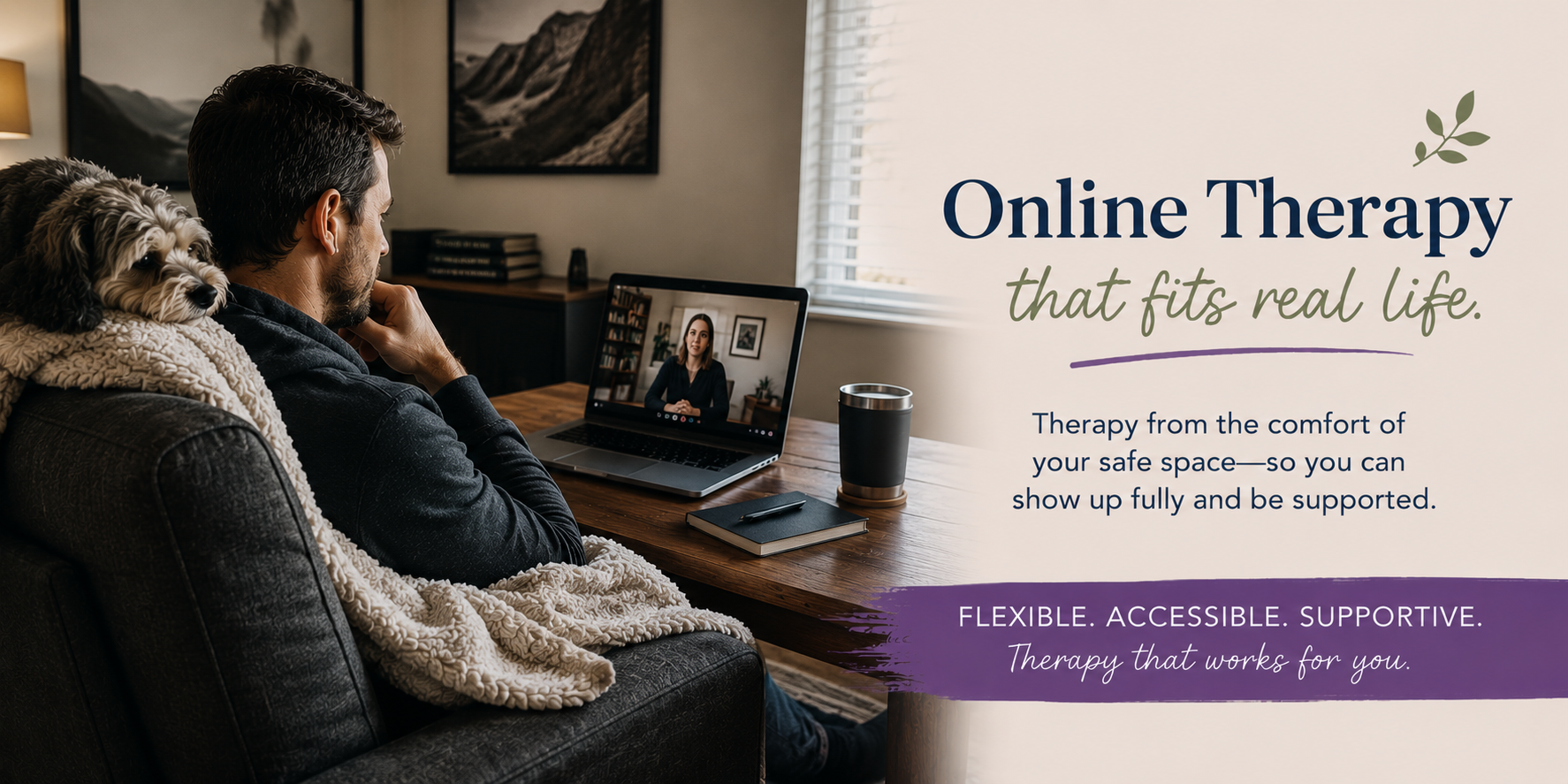
A lot of people are skeptical about online therapy at first, which makes complete sense. Is it awkward? Can you actually connect with someone through a screen? Does it work as well as sitting in a real office? Those are valid questions, and they deserve honest answers. What I can tell you is that a lot of my clients come in with those exact doubts and then, somewhere along the way, realize they actually prefer it. Not because virtual therapy is universally better, but because for many people, it fits their lives and their nervous systems in ways they didn't expect.
Being in a Space You Choose Changes Things
This one surprises people the most. There's a particular kind of pressure that comes with going somewhere new to do something emotionally difficult. You drive to an unfamiliar office, sit in a waiting room and potentially see other people, and try to get yourself into a headspace where you can open up to someone you maybe just met. Then when the session ends, you walk back through that waiting room, drive home, and figure out how to re-enter your life.
Online therapy takes a lot of that out of the equation. You're already somewhere you feel comfortable. Your couch. Your favorite chair. Wrapped in a blanket with a cup of coffee. Perhaps in your car in your favorite park, if home isn’t an ideal place to have sessions. The familiar surroundings actually do something physiologically. Your nervous system isn't working as hard just to be there, which leaves more space to actually do the work.
Then there's this: there's something very different about crying on your own couch versus having to pull yourself together before you walk through a waiting room to drive home.
Pets Are Surprisingly Great for This
If you have a dog or a cat, there's a good chance they'll end up joining your sessions eventually. Honestly, let them. They can be a great support.
Animals are remarkable at grounding people during hard conversations. I've seen clients talk through things they'd been holding for years while their cat settled into their lap, or their dog pressed against their side. There's something about that contact that makes it easier to stay in the room with difficult feelings instead of shutting down.
It's not magic, but it's also not nothing. Pets provide a kind of calm, nonjudgmental presence that can genuinely help regulate the nervous system when things get heavy. In-person therapy offices don't typically come with that option (although some do have therapy dogs on occasion!).
You Don't Have to Drive Home After a Hard Session
This is something people rarely think about until they've experienced it, and then they never stop appreciating it.
Therapy can bring up a lot. Sometimes you finish a session feeling lighter and clear-headed. Other times you've just dug into something raw and you need time to process before you're ready to interact with the world again. In-person therapy doesn't always allow for that. You walk out, get in your car, sit in traffic, and the transition happens whether you're ready or not.
With virtual therapy, when the call ends, you're already home. You can journal, take a walk, sit quietly for a few minutes, let your dog outside, make tea. The space between the session and the rest of your day belongs to you. For people doing deep work, that transition time can matter a lot.
It's Easier to Fit Into an Actual Life
Therapy is one of those things that people know they need and still struggle to make happen consistently. Scheduling, commute time, finding parking, getting back to work afterward… for people who are already stretched thin, those logistics add up.
Online therapy makes the barrier lower. A lot of clients schedule sessions during a lunch break, while their kids are at school, or from their car in a parking lot when that's the only private space they have that day. Virtual therapy opens up options that didn't exist before for parents, busy professionals, and people who live in areas where there isn't a lot of nearby mental health support.
There's a particular pattern I see with high-functioning, anxious people: therapy keeps getting pushed back because it feels like one more thing to manage on an already overwhelming list. Having one less logistical hurdle can be the difference between actually going and not going.
Online Therapy Makes It Easier to Find the Right Fit
This might be the most under-appreciated benefit. Finding a good therapist has always been about more than proximity. You need someone whose approach matches what you're dealing with, whose personality you can connect with, and who actually has experience with what you're bringing in. When you're limited to whoever is within driving distance, your options can get narrow fast, especially if you don’t live in a highly populated area.
Geography matters even more for people with specific needs.
For queer folx, finding affirming care locally can be genuinely difficult depending on where you live. Affirming means more than a therapist who isn't hostile. It means someone who understands queer and trans experiences without requiring you to spend sessions educating them. In more rural or conservative areas, that kind of care can be nearly impossible to find in person with someone you don’t already know socially. Online therapy changes what's available because the therapist just needs to be licensed in the state - they don’t have to have an office in your town.
For people healing from religious trauma or high-control religion, the local options can feel especially complicated. When your entire community is embedded in the same religious culture you're trying to work through, the fear of running into someone you know is real. Seeking out a secular therapist can feel like a visible act of departure from your community. Virtual therapy allows people to access specialized, trauma-informed support without anyone in their community knowing they're doing it.
When Virtual Therapy Isn't the Right Fit
This is worth talking about honestly, because online therapy doesn't work well for everyone.
Privacy is the biggest practical issue. If you don't have access to a space where you can speak freely, it's hard to do meaningful work. That might mean you live with family members who don't know you're in therapy, or a partner you're not ready to talk openly around, or kids who can't reliably be occupied elsewhere. Some people choose to do therapy from their car, but this relies on having a good enough cell signal to maintain the virtual connection.
For some LGBTQIA+ people, being closeted at home creates a real problem. The safety and privacy that make virtual therapy appealing for some people in that situation can be unavailable for others.
There are also people who genuinely need the in-person experience to feel connected. The physical reality of being in a room with another human being helps some people open up and regulate in ways that a screen can't replicate. That's not a personal failing. Different nervous systems need different things. And for people navigating more acute crises or certain diagnoses, in-person care may be clinically more appropriate.
Reliable internet is the practical foundation all of this rests on. If your connection is unstable, the sessions become frustrating in a way that undermines the work.
What Actually Matters Most
The format of therapy is secondary to whether you feel safe, understood, and genuinely connected to the person you're working with. Some people find that online. Some find it in person. Some try one and switch to the other. What tends to matter is finding someone who gets what you're carrying and can sit with you in it without flinching.
Online therapy isn't for everyone. For a lot of people, though, it ends up feeling far more natural and accessible than they expected. If you're curious about online therapy for anxiety, perfectionism, religious trauma, or LGBTQIA+ affirming care, you can learn more about working together here.