

Grounding for Anxiety: Simple Techniques to Calm Your Body and Mind
When anxiety kicks in, it can feel completely overwhelming. Your thoughts race. Your breathing speeds up. Your heart pounds. Your most basic instincts are telling you to fight, flee, or freeze.
That response exists for a reason. If you're faced with a genuine threat to your safety, you need it to launch you into action. The challenge comes when your nervous system triggers that same response to things that aren't actually a threat to your survival, like a looming deadline, a difficult conversation, an inbox full of unread emails, or a mistake that, in the grand scheme of things, doesn't matter much at all.
For people navigating high-functioning anxiety or toxic perfectionism, this can be a near-daily experience: performing well on the outside while feeling dysregulated on the inside. Grounding techniques are some of the most effective tools for interrupting that cycle.
What Is Grounding, and Why Does It Work?
Grounding techniques work by reconnecting you to the present moment, meaning what's actually happening right now, in your body and your immediate environment. When you're anxious, your mind is usually somewhere else: rehearsing a future catastrophe, replaying a past mistake, or spinning out on a worst-case scenario.
Bringing your attention back to the present interrupts the anxiety loop. It slows the physiological stress response and gives you enough mental clarity to assess your situation and make a plan, rather than just react.
These techniques work for anyone feeling heightened emotions or overwhelmed. They're especially helpful if anxiety tends to live in your body (tension, racing heart, shallow breathing) or if your mind has a hard time switching off.
Here are a few of my favorites:
Five Senses Grounding (5-4-3-2-1)
This is one of my go-to techniques, especially in public or at work, because it's completely invisible to anyone around you.
Start by taking a few slow, deep breaths - in through your nose, out through your mouth. Then work through your senses:
5 things you can see — Look around and deliberately name five things in your environment. If you need to make it more engaging, choose five things that are the same color.
4 things you can feel — Notice your feet on the floor, your clothing against your skin, the texture of something within reach. Some people keep a small object in their pocket specifically for this.
3 things you can hear — Tune into sounds you normally filter out: the hum of an HVAC system, traffic outside, voices in another room, birds or insects.
2 things you can smell — Notice the scent of the space you're in. A small bottle of essential oil or even a packet of a familiar spice can be a helpful thing to keep on hand.
1 thing you can taste — A piece of chocolate or a hard candy works well here.
By the time you've worked through all five senses, your nervous system has usually shifted noticeably.
Literal Grounding: Bare Feet on the Earth
This one sounds almost too simple, but don't underestimate it.
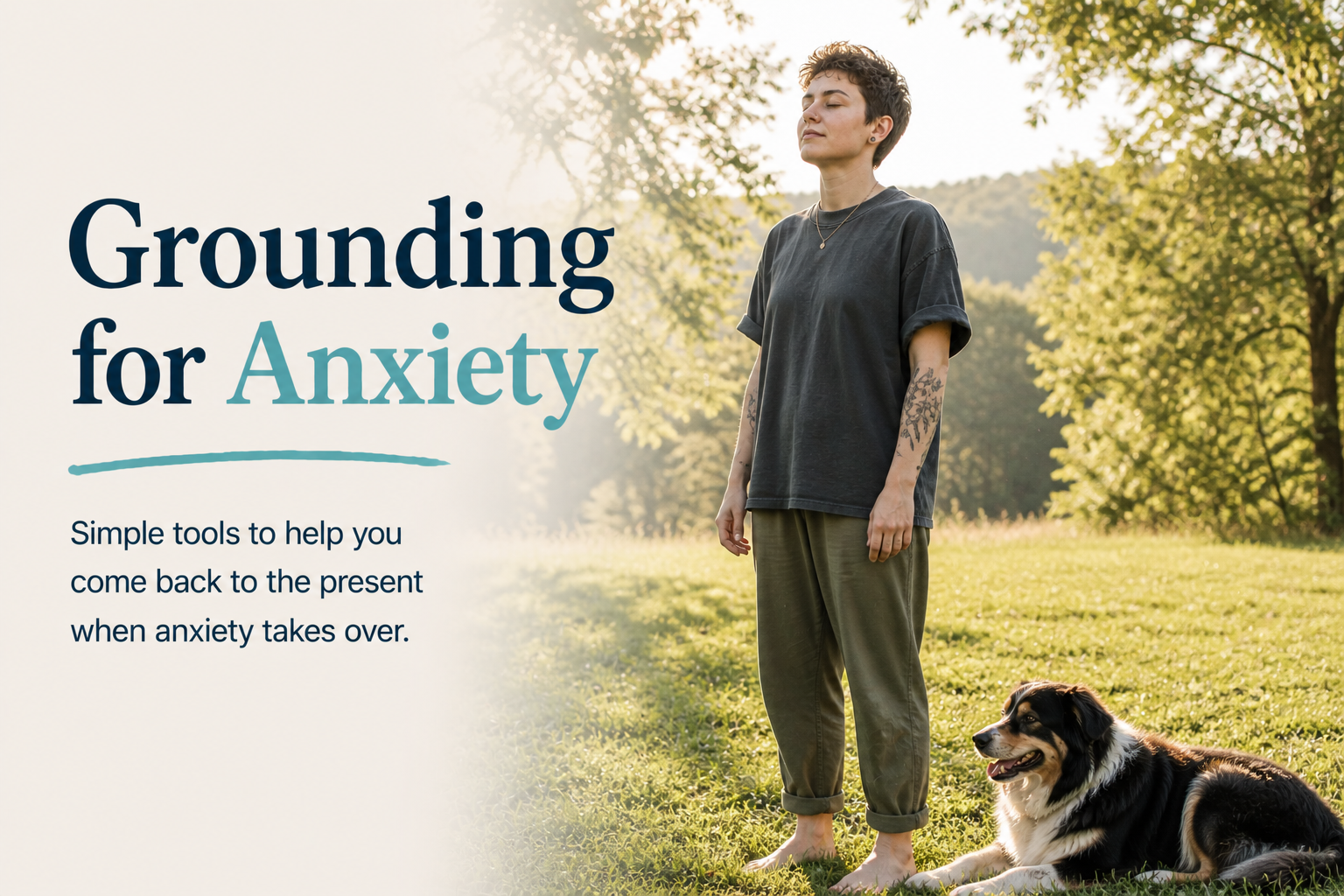
Taking your shoes off and standing directly on grass, soil, or sand is one of the oldest and most natural forms of grounding available to us. There's emerging research on "earthing" suggesting that direct physical contact with the ground may help regulate the body's stress response, and whether or not you dive into the science, most people find it genuinely calming.
There's something about the sensory experience - the cool, uneven texture of grass under your feet, the smell of the outdoors, the shift in your breathing that tends to happen when you step outside - that naturally pulls your attention into the present moment.
If you're working through high-functioning anxiety or perfectionism, this can be especially useful as a daily reset: a few minutes outside, shoes off, just standing or walking slowly on the ground. It's low-effort, requires no supplies, and gives your nervous system a chance to downregulate.
Box Breathing
Box breathing is a simple breathwork technique used by everyone from therapists to military personnel to manage acute stress.
Here's how it works:
Inhale slowly for 4 counts
Hold for 4 counts
Exhale slowly for 4 counts
Hold for 4 counts
Repeat this cycle four times. The deliberate, rhythmic breathing activates your parasympathetic nervous system — the "rest and digest" counterpart to the fight-or-flight response — and signals to your body that you're safe.
This one is especially useful before high-stakes situations: a difficult meeting, a presentation, a hard conversation.
Cold Water Reset
When anxiety is acute and your thoughts are spinning fast, cold water can work quickly to interrupt the stress response.
Splashing cold water on your face, running it over your wrists, or even briefly submerging your face in a bowl of cold water activates what's called the dive reflex — a physiological response that slows the heart rate and promotes calm. It's not glamorous, but it works.
This is a particularly useful technique when other grounding methods feel impossible to focus on because the anxiety is too intense.
When Grounding Isn't Enough
Grounding techniques are genuinely powerful tools, and they work best as part of a broader approach to managing anxiety, perfectionism, or emotional dysregulation. If you find yourself using these skills regularly just to get through the day, that's worth paying attention to.
Therapy can help you understand what's driving the anxiety, not just manage it in the moment.
If you're in Tennessee, Florida, Utah, or Ohio and you'd like to explore what that work might look like, I'd welcome you to reach out. We can start with a phone consultation to talk about what you're experiencing and whether working together feels like a good fit. Just click the Schedule Now button to set up your consultation call.