
How to Protect Your Mental Health on Social Media
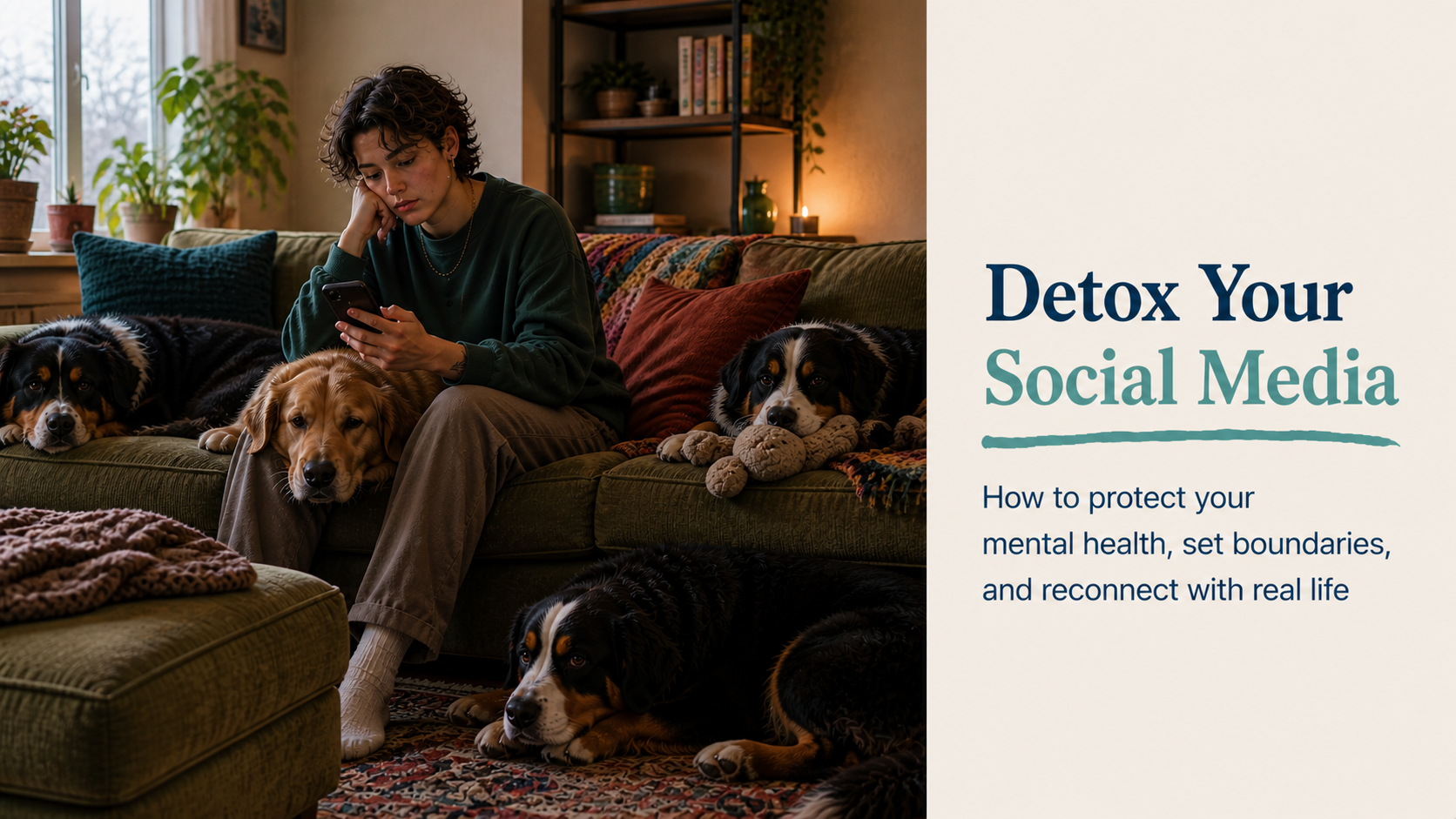
Social media has a complicated relationship with our mental health and most of us know it. We pick up our phones for "just a few minutes" and surface an hour later feeling vaguely worse about ourselves, the world, or both. We watch other people's highlight reels and compare them to our behind-the-scenes realities. We get pulled into comment sections we never intended to enter and see the very worst of the world around us.
The research has caught up with what most of us have felt for a while: heavy social media use is consistently linked to higher rates of anxiety, depression, and loneliness, particularly when it involves passive scrolling and social comparison.
That doesn't mean you have to delete everything and go off the grid. Many people have real connections through social media with family they don't see often, friends who've moved away, and communities they genuinely value. The goal isn't to throw it all out. The goal is to make your feed work for you instead of against you.
Here are some practical ways to do that.
1. Stop Following Influencers
This one has only gotten more relevant since the rise of Reels and TikTok. Influencer culture has expanded enormously. Now it's not just polished Instagram photos, it's short-form video after short-form video of people with perfect bodies, perfect homes, perfect routines, and perfect lives, interrupted only by a sponsored product you should buy to be more like them.
None of it is real. Or rather, all of it is a curated sliver of reality, filtered, edited, and optimized for engagement. No one's life looks like that from the inside.
The problem is that our brains don't always make that distinction in real time. We see it, we feel it, and we compare. Stop following accounts that consistently leave you feeling like your life doesn't measure up. If an account makes you feel inspired or genuinely good, keep it. If it makes you feel inadequate, unfollow it, regardless of how many followers they have or how much everyone else seems to love them.
2. Mute or Hide the People Who Drain You
We all have them: the family member whose political posts make your blood pressure rise, the friend whose humble-brag updates leave you feeling small, or the contact whose relentless negativity colors your whole day.
You don't have to unfriend or unfollow them. Every major platform now has a mute or hide function that lets you quietly remove someone from your feed without any social fallout. They won't know. You won't see their posts unless you go looking. It's a low-drama, low-stakes way to curate a healthier experience without any awkward conversations at Thanksgiving.
Use it liberally. Your feed should not be a source of dread.
3. Unfriend and Unfollow People You Don't Actually Want in Your Life
This one can feel uncomfortable, but sit with it for a second. You don't talk to them. You don't see them in person. If you ran into them somewhere, you'd probably find a reason to walk the other direction. Why are they in your daily life?
Keeping someone connected to you on social media out of obligation or conflict avoidance means choosing a low-level ongoing discomfort over a one-time moment of awkwardness. Most people don't notice when they've been unfollowed. If they do, that might tell you something important about whether that's a relationship worth protecting in the first place.
4. Be Intentional About What You Post and Comment
This one often gets overlooked: everything you put on social media is an invitation for others to interact with you. Most of the time, that's fine. But comment sections, especially on anything remotely controversial, can turn quickly, and strangers on the internet can be genuinely cruel in ways they'd never be face to face. It’s also a good idea to visit your privacy settings and make sure your page isn’t public. There’s no need to create the opportunity for strangers and people you don’t want to interact with to comment on your posts.
Before you comment on something, it's worth a moment's pause: is this worth the potential response? That's not about self-censorship. It's about being selective about which conversations you actually want to be in.
If someone is ugly to you in a comment section and you don't know them, block them. You don't owe anyone access to your space online. The block button exists for exactly this reason.
5. Audit Your Algorithmic Diet
This is something that didn't exist in the same way a few years ago, but it matters a lot now. Every platform including Instagram, TikTok, Facebook, and YouTube has an algorithm that learns what keeps you engaged and feeds you more of it. If you've been watching a lot of diet content, fitness content, news content, or anything that spikes your cortisol, the algorithm has noticed and will keep serving it up.
You can reset this deliberately. On most platforms, you can tell the algorithm you're not interested in specific content, or you can actively seek out and engage with content that makes you feel good, which trains the algorithm in a different direction. It takes some intentional effort at first, but your feed can genuinely become a different place within a few weeks if you work at it.
6. Set Limits on Your Time
It's easy to think you'll check in for a few minutes and surface an hour later with no idea where the time went. That's not an accident. These platforms are designed specifically to keep you scrolling.
Most phones have built-in screen time tools that let you set daily limits on specific apps. Use them. Decide in advance how much time you're willing to give social media each day and treat that as a real boundary. Some people also find it helpful to designate no-phone times during meals, during family time, in the first hour of the morning, or in the hour before bed to create natural breaks from the scroll.
A Final Note
Social media isn't going anywhere, and it's not entirely bad. Real connection, real community, and real joy happen there, too. It works best when you're in charge of how you use it rather than letting it use you.
If you've noticed that social media is contributing to anxiety, depression, or a persistent sense of not measuring up, that's worth paying attention to. Sometimes a feed audit is enough. Sometimes what's underneath the social comparison - the self-doubt, the perfectionism, the need for external validation - is worth exploring in a deeper way.
If you're in Tennessee, Florida, Utah, or Ohio and you'd like to work through some of what's underneath, I'd welcome the conversation.